Copyright © 2026 - orienthink Team. All Rights Reserved
Information from your device can be used to personalize your ad experience.

Copyright © 2026 - orienthink Team. All Rights Reserved
Information from your device can be used to personalize your ad experience.
How to validate a business idea before spending money using customer interviews and low-cost experiments. Find practical next steps before you invest.
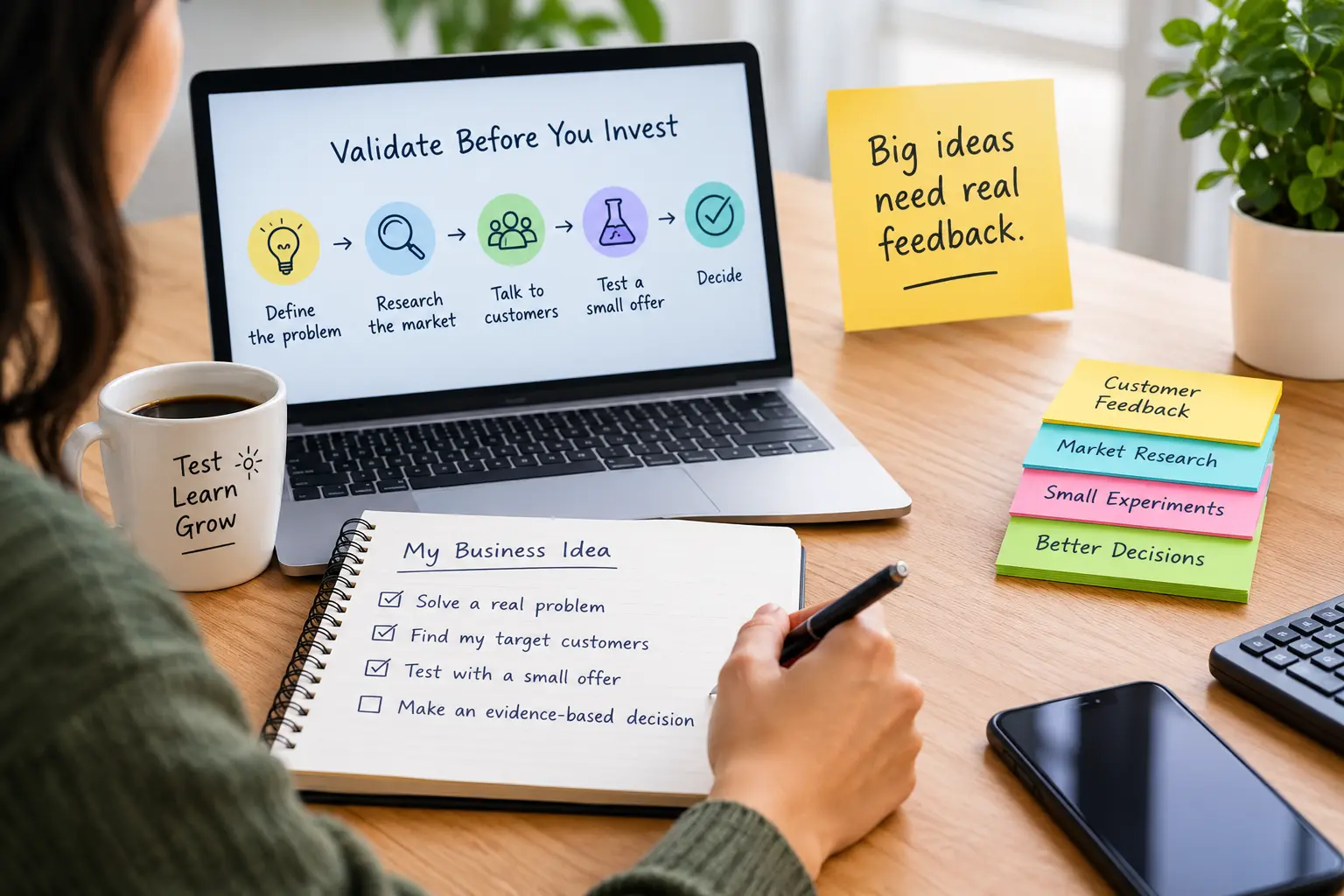
How to validate a business idea before spending money starts with one question: what evidence would convince you that real customers need your solution? Before buying inventory, developing an app, or renting premises, you can investigate the problem, study existing alternatives, and test a small offer. The challenge is distinguishing genuine demand from encouraging compliments. This guide explains how to identify risky assumptions, research your market, conduct useful customer interviews, and run affordable experiments before deciding whether to proceed, revise, or stop.
Business idea validation means collecting evidence that a specific customer group has a meaningful problem and may value your proposed solution. It reduces uncertainty; it cannot guarantee future sales or profitability.
Start by defining four things: who experiences the problem, what happens, how they currently manage it, and why existing alternatives fall short. Then list your assumptions and rank them by uncertainty and the consequences of being wrong.
For example, a student considering a tutoring service might begin with “students need better academic support.” That statement is too broad to test. A more useful hypothesis might be that students in a particular course struggle with specific concepts and cannot find convenient, understandable explanations at a price they can afford.
The next step is to identify which assumptions could invalidate the idea. You might assume students experience the problem frequently, can find your service, trust your teaching, and will pay enough to make delivery worthwhile.
Use this worksheet to turn those assumptions into testable questions.
| Assumption | Evidence needed | Cheapest credible test | Decision rule |
| Students struggle with the topic | Recent examples and existing workarounds | Customer interviews | Look for recurring, specific problems |
| Students can find the service | Responses from the intended audience | Targeted outreach | Record qualified inquiries |
| Students will pay | Responses to a clearly priced offer | Transparent paid pilot | Track actual payment commitments |
| Delivery is practical | Time and resource requirements | Small manual trial | Compare delivery effort with expected revenue |
These decision rules should be defined before testing, rather than adjusted afterward to make disappointing results appear positive. Strategyzer’s guide to testing business ideas offers further guidance on prioritizing assumptions and designing experiments.
Once you know which assumptions matter most, research the market before developing the service.
Market research for small business helps you understand potential customers, existing competitors, and the conditions affecting demand. It can reveal promising opportunities, but it cannot independently prove that customers will purchase your specific offer.
The U.S. Small Business Administration’s market research guidance recommends examining demand, market size, customer characteristics, competition, and the prices people pay for alternatives. Start with secondary research, which uses existing information, before conducting your own primary research through interviews or direct observation.
For a tutoring service, examine competing tutors, tutoring centers, educational resources, and free learning materials. Read public reviews to identify recurring complaints, such as inconvenient schedules or explanations that do not address particular learning difficulties. These are research clues, not proof that your proposed service will succeed.
The U.S. Census Bureau’s small-business data resources can also help US-focused founders investigate local demographics and economic conditions.
Different evidence sources answer different questions. Use the following comparison to decide what to investigate next.
| Evidence source | What it can establish | Main limitation | Sensible next step |
| Competitor websites and prices | Existing offers and positioning | Published offers do not establish sales | Compare gaps and customer segments |
| Public customer reviews | Reported experiences and frustrations | Reviewers may not represent the whole market | Investigate recurring complaints |
| Search trends and discussions | Topics attracting attention | Attention does not prove purchase intent | Interview relevant customers |
| Official demographic data | Characteristics of a potential market | Population data does not prove demand | Narrow the target audience |
| Direct customer interviews | Specific needs and current workarounds | Small samples are not statistically representative | Test the most important finding |
Competition can indicate that customers already spend money solving a problem, but it also creates a differentiation challenge. Conversely, few competitors may reflect weak demand rather than an overlooked opportunity.
After gathering these clues, identify what your intended customers do today and which unmet need deserves direct investigation.
Customer interviews help you understand a problem through people’s actual experiences rather than your assumptions about their needs. They are particularly useful before investing in product development, inventory, or marketing.
Recruit people who match your intended customer group, not only friends who want to encourage you. Ask neutral questions about recent experiences, existing solutions, previous spending, and what remains frustrating. Avoid presenting your idea too early, because your explanation may influence their answers.
Follow this interview sequence:
The difference between weak and stronger questions matters. “Would you use my tutoring service?” invites polite speculation. “What did you do the last time you needed help, and what would have improved that experience?” explores behavior and unmet needs.
Record recurring patterns, contradictory answers, and differences between customer groups. Do not treat a particular interview count as universal proof: the number needed depends on the audience, the problem’s complexity, and whether meaningful patterns emerge.
Interviews can establish that a problem deserves further investigation, but willingness to pay requires stronger evidence. Use what you learn to design a small experiment.
A validation experiment tests a specific assumption through a measurable action. The goal is to learn whether customers will act on an offer before you invest in a fully developed product or service.
Choose the simplest experiment that can answer your most important remaining question. You might deliver a service manually, demonstrate a prototype, publish a landing page, or offer a clearly described paid pilot.
A minimum viable product (MVP) is a basic version of an offer designed to test its essential value with users. You may not need one initially: a conversation, demonstration, or manual service can answer an earlier question at lower cost.
Compare possible experiments before choosing your approach.
| Experiment | Cost category | Evidence strength | Limitation |
| Manual service trial | Low | Direct delivery experience | Limited capacity |
| Prototype demonstration | Low to moderate | Feedback on usability and understanding | Interest may not translate into purchases |
| Landing page and waitlist | Low to moderate | Measurable interest and inquiries | Sign-ups do not establish willingness to pay |
| Qualified customer inquiry | Low to moderate | Active interest in a specific offer | Inquiry may not become a sale |
| Paid pilot | Variable | Actual payment and delivery evidence | Early customers may not represent future demand |
| Pre-order | Variable | Purchase commitment | Does not prove repeat demand or sustainable economics |
Cost categories are relative; actual spending depends on your business and chosen method. The strongest experiment is not necessarily the most expensive. It is the one that produces relevant evidence for the decision you need to make.
Before you test business idea demand, write down five elements: your hypothesis, target audience, single call to action, measurable outcome, and decision threshold.
Illustrative experiment: The student offers a clearly described tutoring session to relevant students. The hypothesis is that the target group will pay for help with a specific topic. The student records qualified inquiries, bookings, payments, and delivery time. Before outreach, the student defines what response would justify another trial.
A waitlist may be a useful early signal, but a paid pilot provides stronger evidence of willingness to pay. Neither guarantees future success.
Keep every claim about availability, results, and delivery truthful. The Federal Trade Commission’s advertising guidance explains that advertising claims must be truthful, nondeceptive, and evidence-based. Never present an unfinished service as ready for immediate delivery or invent customer testimonials.
Once you have collected customer feedback and tested your idea, the next step is to identify what the evidence actually tells you. Look for patterns in customer responses, compare results against your original assumptions, and use measurable outcomes to guide your next move. Our guide to data analysis techniques for business decisions explains how to turn raw data into useful insights for more informed decisions.
Once the experiment ends, interpret the results alongside delivery feasibility and financial viability.
The final decision should combine customer demand, access to potential buyers, delivery feasibility, and financial viability. A promising response is a reason to investigate further, not automatic permission to make a major investment.
Start by calculating the economics. Revenue is the money received from sales; variable costs change with each sale, while fixed costs continue regardless of sales volume. The break-even point is where revenue covers total costs, leaving neither a profit nor a loss.
Illustrative calculation: Suppose a tutoring session sells for $30, incurs $10 in variable costs, and the service has $200 in monthly fixed costs. Each session contributes $20 toward fixed costs, so the business would need 10 sessions to cover those costs, assuming the figures remain unchanged.
This calculation is illustrative, not a market benchmark. It excludes other potential costs, and revenue above the break-even point does not automatically represent take-home profit.
Use this business idea validation checklist before committing more resources:
Interpret the findings through three possible decisions:
For the tutoring example, recurring complaints without paid bookings might justify testing a different schedule, audience, or offer before abandoning the underlying problem. If a revised offer still produces weak evidence, stopping may be the more reasonable decision.
To move forward, document your findings, identify the largest remaining uncertainty, run the next experiment, and only then consider a larger commitment. How to validate a business idea before spending money ultimately comes down to making each investment proportional to the evidence available.
You do not need to eliminate every uncertainty before starting a business. You need enough relevant evidence to justify the next step without committing more resources than the decision warrants.
Last updated: October 25, 2026