Copyright © 2026 - orienthink Team. All Rights Reserved
Information from your device can be used to personalize your ad experience.

Copyright © 2026 - orienthink Team. All Rights Reserved
Information from your device can be used to personalize your ad experience.
Personal branding for students made simple: learn how to turn coursework into proof, polish your profiles, and start building your reputation. Read the guide.

Personal branding for students usually starts with an awkward moment: you open a profile page, see a blank headline, and realize you have a degree in progress but nothing that shows what you can do. This guide closes that gap with a proof-first method: pick one audience, write one clear positioning sentence, attach evidence from coursework and projects, and share it in one place. You will leave with a claim-to-proof table, a profile checklist, and a four-week plan that fits around classes.
Your personal brand is what people conclude about you from the information they can find and the experiences others share. It is not simply a logo, attractive profile photograph, or collection of motivational posts. It is the connection between what you say about yourself and what your work demonstrates.
For personal branding for students, this distinction matters because you do not need years of professional experience to establish credibility. Your assignments, technical projects, volunteering, research, and extracurricular activities already contain useful evidence.
Think of your brand as a professional reputation that becomes easier to understand when you communicate it consistently. You might want people to associate you with problem-solving, creative thinking, communication, or a particular subject area. However, those descriptions become more convincing when someone can examine an example of your work.
Why skills-based hiring makes evidence valuable
Skills-based hiring means evaluating candidates through the skills they demonstrate rather than relying exclusively on academic qualifications or grades.
According to NACE’s Job Outlook 2026 findings, 70% of participating employers reported using skills-based hiring, compared with 65% in the previous year. This survey involved 183 respondents, including 170 NACE employer members, so it should be understood as a US-based employer dataset rather than a global hiring rule.
NACE also identifies critical thinking and problem-solving, communication, and teamwork among the skills employers consistently seek. Its guidance on the skills-based hiring process encourages students to explain situations where they used their abilities to solve problems.
This creates an opportunity for students who have limited employment history. You can demonstrate relevant skills through academic and extracurricular experiences.
Example: Imagine two students studying the same business degree. The first describes themselves as creative, hardworking, and passionate about business. The second presents a market research assignment, explains their role in analyzing survey responses, and identifies the findings they produced.
The second student gives a reader something concrete to evaluate. The difference is not necessarily greater experience; it is clearer evidence.
Remember this principle: personal branding is not about convincing everyone that you are impressive. It is about helping the right people understand what you can actually contribute.
To build a personal brand as a student, begin by deciding who needs to understand your abilities and what you want them to remember. Without this decision, your profile can become a collection of unrelated interests.
Positioning means establishing a clear place for yourself in the mind of a particular audience. In practical terms, it connects three things: who you are, what you can contribute, and why that contribution matters to someone.
Start with your next opportunity
Your audience should relate to something you realistically want to pursue within the next 12 months. For example, consider these possibilities:
You do not have to choose a permanent career identity. Your first positioning decision simply gives your professional communication a useful direction.
Use a repeatable positioning formula
A personal brand statement is a short description that connects your current stage, field, contribution, audience, and supporting evidence.
Use this formula: I’m a [stage and field] student who [does what] for [audience], shown by [proof].
Weak statement: The problem is that this statement provides several adjectives but no clear direction or evidence.
“I’m a passionate business student who is hardworking, creative, and interested in many areas of business.”
Improved statement: The improved version communicates a field, contribution, audience, and example of relevant work.
“I’m a business student who helps small organizations understand customer preferences through survey research and data analysis, demonstrated through academic market research projects.”
What if you have several interests?
You do not need to remove every secondary interest. Instead, choose one primary direction and mention another interest where it adds useful context.
For example, a student interested in both digital marketing and graphic design might position themselves around visual communication for small businesses. Their profile can then mention marketing as a complementary interest.
Use this decision rule: choose the direction for which you can produce convincing evidence within 30 days. If two options seem equally attractive, prioritize the one most closely connected to your next opportunity.
Once your positioning statement feels clear, use it as the foundation for collecting evidence.
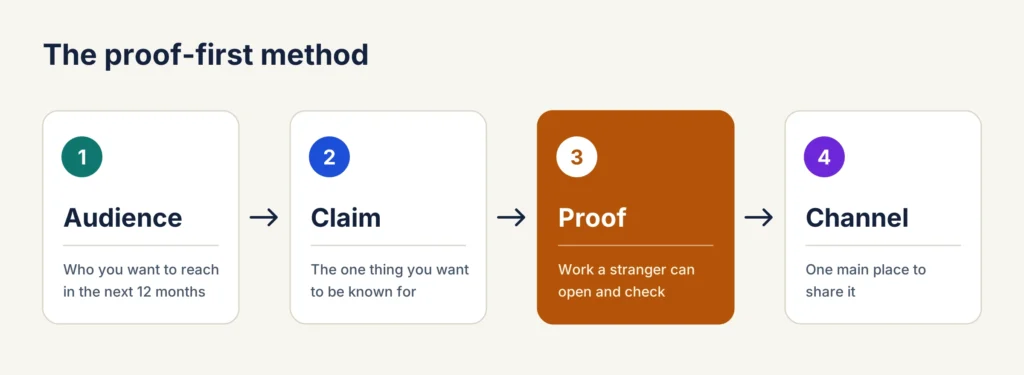
You can develop a credible professional presence without internships or extensive employment history. The starting point is identifying useful evidence from work you have already completed.
A claim is something you want people to associate with you, such as analytical thinking, organisation, creativity, or communication. Proof is an example that another person can examine to understand why that claim is reasonable.
This distinction is particularly useful when learning how to build a personal brand with no experience. You do not need to invent achievements or exaggerate your abilities. Instead, look at the work you have completed and explain your contribution clearly.
Build a Claim-to-Proof Ledger
A Claim-to-Proof Ledger connects each professional strength with evidence, its location, and any missing information you need to address. The following is an template for a business student. The examples are fictional and are not presented as real student achievements.
| Claim | Proof | Where it lives | Gap to fix |
| Analytical thinking | Market research assignment involving survey analysis | Academic project document | Add a clear explanation of the findings |
| Organisation | Budget planning for a student society event | Event planning report | Explain your individual responsibilities |
| Communication | Group presentation explaining research findings | Presentation slides | Include your contribution and audience |
| Creativity | Logo concept created for a friend’s shop | Design sample | Obtain permission before publishing |
The final column is especially useful because it prevents you from treating an unfinished example as complete evidence. Sometimes you already have the right project but need a better explanation, clearer documentation, or permission to share it.
Turn one assignment into a short case study
A case study explains the problem, your contribution, the actions you took, and what you learned. It gives readers more context than simply listing a project title.
Use this five-line structure:
Example: A student completes a market research assignment about customer preferences. Their case study explains the research question, their responsibility for analyzing responses, the process used to organize findings, the resulting recommendations, and what they learned about interpreting customer information.
Notice that the example does not require an impressive revenue figure or a famous client. It simply explains the work honestly.
NACE’s research identifies problem-solving, communication, and teamwork as important employer interests. Its guidance encourages students to connect their experiences with the skills required for the opportunities they pursue. Therefore, your ledger should reflect both technical abilities and transferable skills.
The practical rule is straightforward: never keep a professional claim without supporting evidence. Either find an example that demonstrates it or make it a development goal for a future project.
Once you have a clear direction and supporting evidence, choose where people should find your work. Consistency across your professional profiles makes your identity easier to understand. You do not need to publish everything everywhere. One main channel, supported by a small collection of relevant work, is usually a sensible starting point.
Start with a focused LinkedIn profile for students
Your LinkedIn profile should communicate your current stage, professional interests, relevant skills, and evidence of completed work. Treat it as a short professional introduction rather than an online version of your entire academic history.
Use this profile consistency checklist before sharing your profile:
The value of this checklist is consistency. Your headline, summary, and project descriptions should support the same professional direction rather than introducing unrelated claims.
LinkedIn’s official public profile URL guidance explains how members can customize their public profile URLs. Its help page also describes availability and the conditions for changing them, which you should confirm before making changes.
Create a small student portfolio
A student portfolio is a curated collection of work that demonstrates your abilities through examples. It can be particularly useful when your field involves design, writing, programming, research, or other work that benefits from visual or detailed explanation.
Start with two to four relevant items rather than trying to document everything you have ever completed. Each portfolio item should explain:
For a visual project, include clear images of the completed work. For a research assignment, explain the research question and summarize the findings. For a technical project, describe the problem, your contribution, and the resulting work.
Example: Instead of writing “Interested in graphic design,” a student could present a small collection of design concepts, explain the purpose behind each one, and describe the design decisions they made.
Choose your main channel based on your goal
If you are applying for internships or graduate opportunities, prioritize LinkedIn. If your work is primarily visual, make a small portfolio your main presentation space. If you are starting a freelance practice, organize your examples around the services you can offer.
Avoid spreading yourself across several platforms before establishing a consistent foundation. A complete profile and a few well-explained projects are more useful than multiple unfinished accounts.
Your next priority should be maintaining an authentic and appropriately private online presence.
Authentic personal branding means your public claims match your actual abilities, experience, and communication style. You should not need to pretend to be more experienced than you are to establish a professional reputation.
A good profile communicates both your current abilities and the areas you are developing. This makes your professional identity more believable and easier to maintain as your experience changes.
Check what people can find about you
A personal brand audit for students should include a review of existing search results, public profiles, and information connected to your name. Start with a simple self-search routine:
If your name is common, add a relevant academic or professional term to make the search more useful.
Google’s Results about you tool can help people identify certain search results containing personal contact information, including home addresses, phone numbers, and email addresses.
Google also allows eligible removal requests for certain results. However, removing a result from Google Search does not automatically delete the original information from the website where it appears. Some requests may also be denied when the information appears on pages considered valuable to the public.
Use AI without losing your own voice
AI can help organize your ideas, improve sentence structure, and identify unclear explanations. However, the information it produces should not replace your actual experience. Start by writing down your real responsibilities, completed work, and skills. You can then use AI to organize those details into a clearer draft. Before publishing, check every claim against your original work. Remove achievements, technical abilities, results, or responsibilities that you cannot verify. Also follow your institution’s academic-integrity requirements and any relevant employer or client publishing rules.
Apply the three-question publish test before sharing a professional update, project, or personal statement, ask yourself:
If you cannot answer yes to these questions, revise the content before publishing. Never share confidential internship information, private client material, or restricted group-project documents. Avoid publishing personal contact details that are unnecessary for professional communication.
A useful reputation is built through consistent, accurate information rather than constant visibility. With your profile and privacy boundaries established, you can move towards a manageable publishing routine.
You can establish the first version of your professional presence without spending every evening creating content. Set aside approximately two hours each week and complete one focused task at a time.
Follow this four-week sequence:
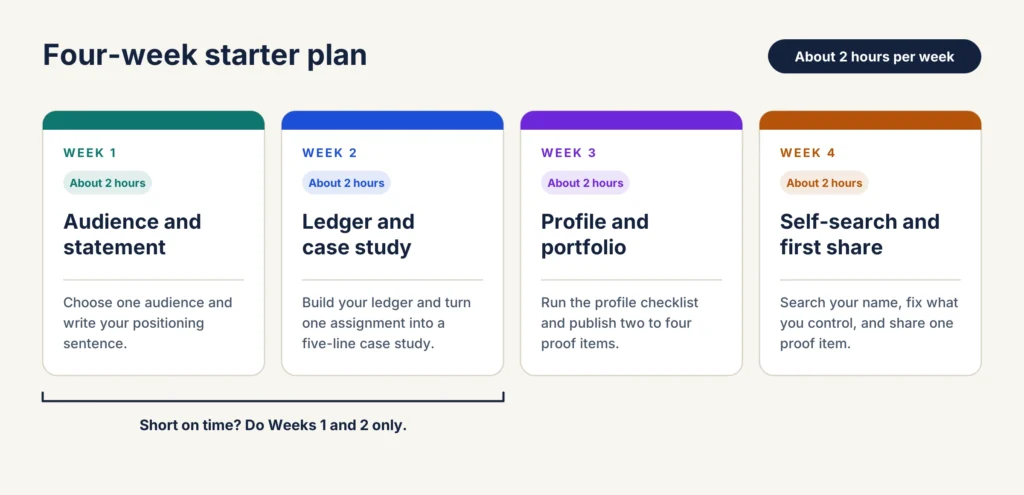
The sequence matters because publishing before identifying your audience and evidence can create unnecessary work. Establish your message first, then prepare the material that supports it.
If your academic schedule is particularly busy, complete Weeks 1 and 2 first. A clear direction and an organized collection of evidence provide a useful foundation even before you begin publishing.
Personal branding for students does not require a large audience, an impressive job title, or a constant stream of updates. It requires a clear explanation of what you are learning, what you can contribute, and where someone can examine your work.
Use this five-item checklist to keep improving your professional presence:
The goal is not to create a perfect professional identity immediately. Your experience will develop, and your public profile should develop alongside it. Start with what you can demonstrate today, communicate it honestly, and allow your work to strengthen your reputation over time.
Last updated: November 4, 2026.